
Battle of Haldighati: Maharana Pratap’s Challenge to the Mughal Army
When and Where Did the Battle of Haldighati Take Place?
June 18, 1576, is considered a symbol of bravery, sacrifice, and self-respect in Indian history. On this day, a fierce battle was fought in Haldighati, a mountain pass in the Aravalli range located in present-day Rajsamand district of Rajasthan. The soil of this घाटी (valley) has a yellowish color resembling turmeric, which is why it is called Haldighati. This battle was fought between the brave ruler of Mewar, Maharana Pratap, and the massive army of the Mughal emperor Akbar. The Mughal forces were led by Raja Man Singh I of Amber, while Maharana Pratap himself commanded his army. This was not just a battle between two rulers—it was a struggle between independence and imperial domination. Maharana Pratap dedicated his life to one goal: protecting the freedom and honor of Mewar. Despite being heavily outnumbered, Maharana Pratap fearlessly accepted the challenge. This battle holds a special place in Indian history as it showcases extraordinary courage, strategy, and resilience.
Background and Causes of the War
Before the Battle of Haldighati, Akbar made several diplomatic attempts to persuade Maharana Pratap to accept Mughal suzerainty. He sent envoys and commanders four times with proposals for alliance, but each time he faced rejection. Maharana Pratap firmly believed that freedom could not be compromised at any cost. For him, the independence of Mewar and the dignity of his ancestors were above everything else. When all diplomatic efforts failed, Akbar resorted to military action and sent a massive army towards Mewar under the leadership of Man Singh.
Course of the Battle and the Fierce Conflict
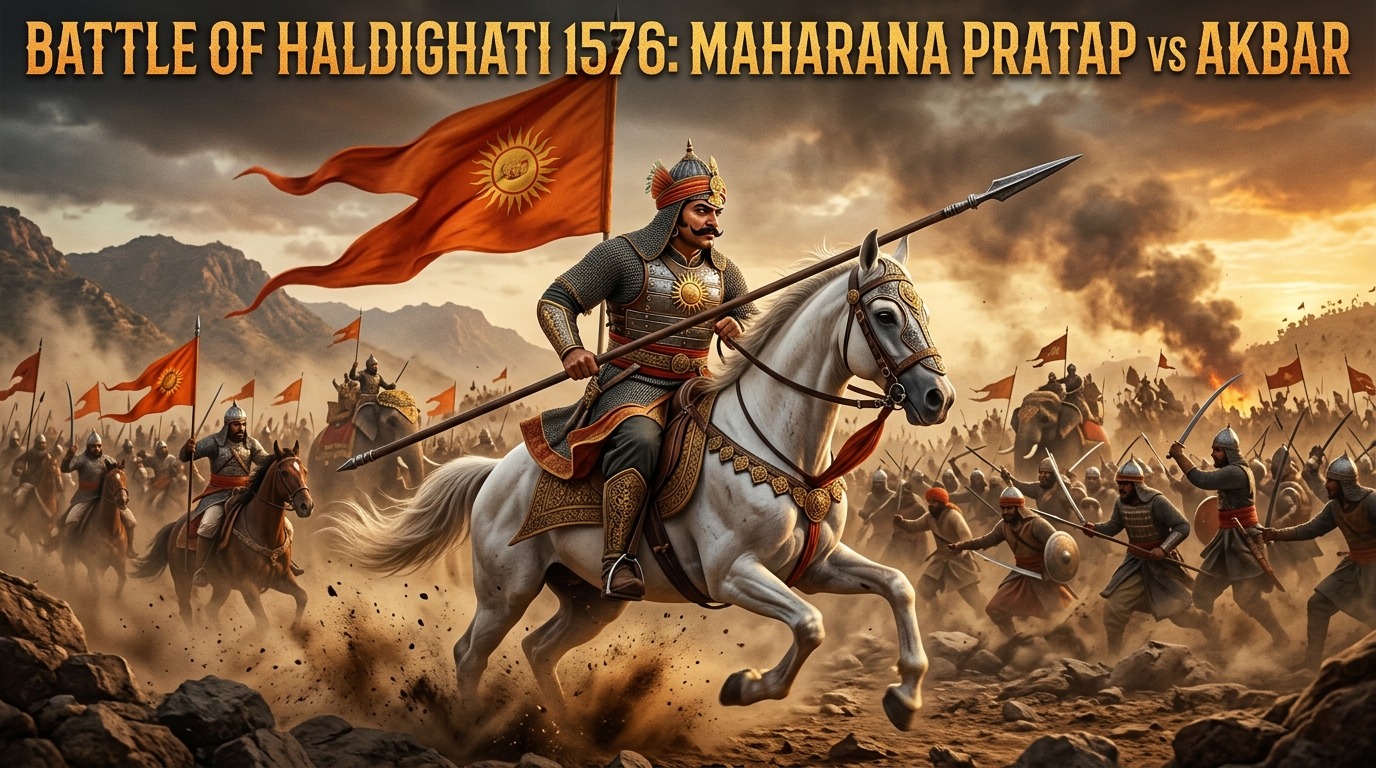
The Battle of Haldighati was intense and dramatic. Right from the beginning, Maharana Pratap’s forces took an aggressive stance. The vanguard (Harawal) of Pratap’s army was led by Hakim Khan Sur, who launched such a powerful attack that the Mughal army was pushed back nearly 7 kilometers to Molela in the early phase. During the battle, Maharana Pratap displayed exceptional bravery. It is said that he killed Mughal commander Bahlol Khan in a single blow along with his horse, spreading fear among the Mughal ranks. At one point, Maharana Pratap, riding his loyal horse Chetak, charged directly into the center of the Mughal army. Chetak leaped onto the head of Man Singh’s elephant, allowing Pratap to strike a powerful blow with his spear. Although Man Singh managed to survive, his mahout was killed. This incident shook the morale of the Mughal forces and created panic among them.
Man Singh’s Retreat and Refuge in Gogunda
During and after the battle, the condition of the Mughal army deteriorated significantly. Terrified by Maharana Pratap’s relentless attacks, Mughal forces retreated from the battlefield. Man Singh fled to Gogunda and took shelter in a fort. So fearful was he that he ordered deep trenches to be dug around the fort for protection. Maharana Pratap not only fought bravely but also used strategic warfare effectively. He cut off the Mughal army’s supply lines in Gogunda. As a result, Mughal soldiers faced severe shortages of food and water. Many were forced to eat the meat of dead horses and survive on raw mangoes, leading to illness and suffering. For nearly four months, the Mughal army remained trapped in the fort like prisoners. When Man Singh eventually returned to Akbar’s court, he faced criticism and neglect. Enraged by this failure, Akbar reportedly distanced Man Singh from the royal court for some time.
Akbar’s Continued Campaigns After Haldighati
Attempts from 1577 to 1582 and Failure to Conquer Mewar
Even after the Battle of Haldighati, the conflict did not end—it marked the beginning of a prolonged struggle. Furious over the setback, Akbar made repeated attempts to subdue Maharana Pratap. Between 1577 and 1582, he launched multiple invasions, sending massive armies each time. Every year, forces ranging from 60,000 to 100,000 soldiers were deployed towards Mewar. On one occasion, Akbar himself advanced with a huge army as far as Banswara, but failed to achieve success. Finally, on the occasion of Dussehra in 1583, Maharana Pratap achieved a decisive victory in the Battle of Dewair. His son Amar Singh also displayed remarkable bravery in this battle. After this victory, Mughal forces were permanently driven out of Mewar. All 36 Mughal outposts were abandoned, and their soldiers fled. Following this, Akbar never again attempted to conquer Mewar during his lifetime.
Conclusion
The Battle of Haldighati remains an eternal symbol of bravery, sacrifice, and self-respect in Indian history. Although the battle itself lasted only a day, its impact continued for many years. Maharana Pratap proved that even with limited resources, strong determination and patriotism can challenge even the mightiest powers.His life continues to inspire generations, reminding us that the struggle for freedom and honor is never in vain.
